The CPR Doc: Lifesaving Skills, Explained in Rice and Beans
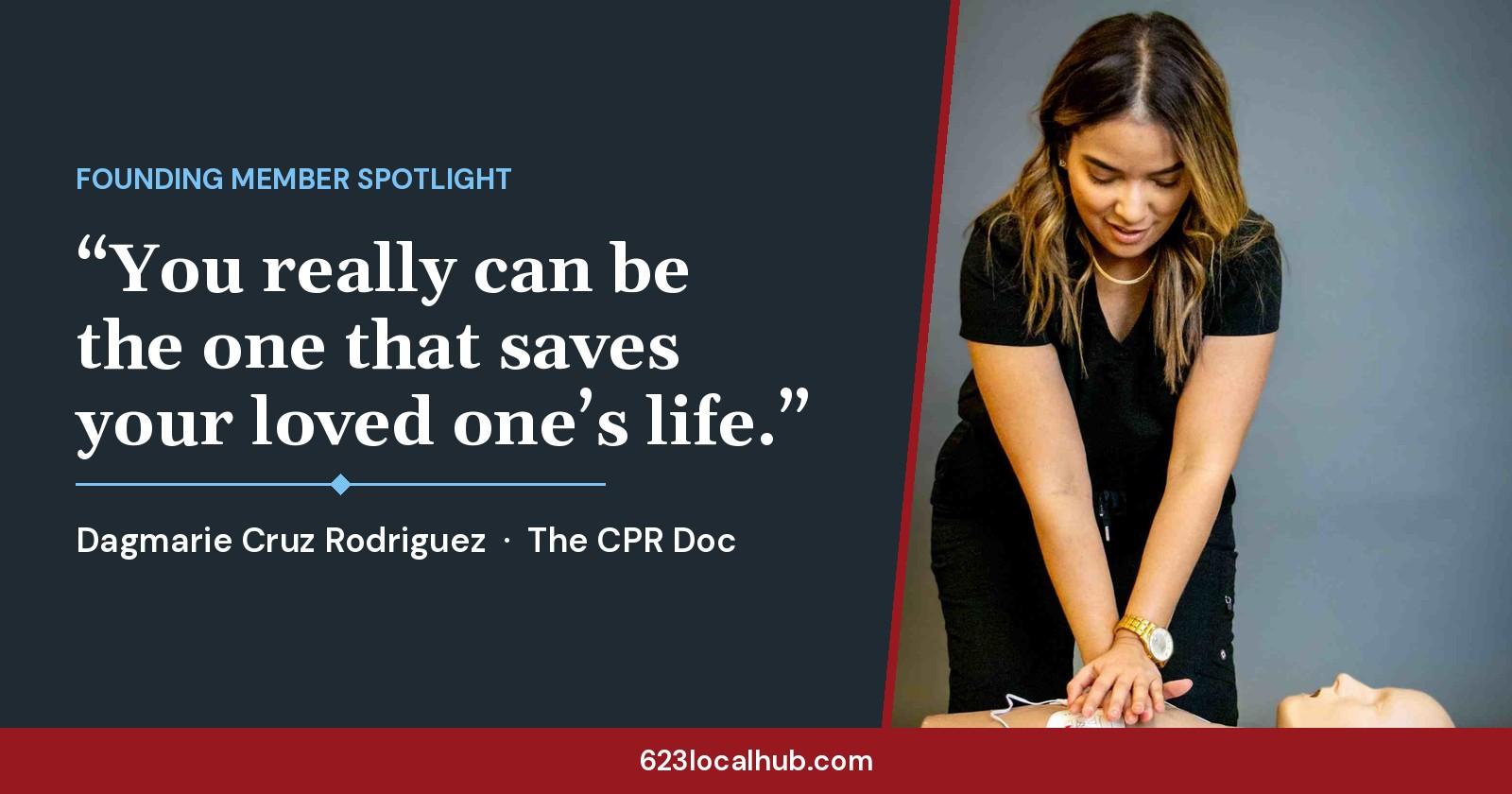
Dagmarie Cruz Rodriguez teaches CPR and first aid across the West Valley in English and Spanish. This December, she's opening a Babysitting Academy for teens.
In Puerto Rico, there's a saying for explaining something so anyone can understand it: put it in rice and beans. Keep it simple. Make it real.
That's how Dagmarie Cruz Rodriguez teaches CPR.
Dagmarie is the founder of The CPR Doc, a training center based at Westgate in Glendale. She teaches CPR, AED and first aid to teachers, caregivers, coaches, students and families, and Basic Life Support (BLS) to healthcare providers. She also teaches child and baby safety, the Stop the Bleed course, and, starting this winter, a full-day Babysitting Academy for teens.
The CPR Doc is certified through the Health and Safety Institute (HSI) and the American Red Cross. CPR, AED and first aid and BLS classes are offered in both English and Spanish.
From medical school to the West Valley
Dagmarie has spent her whole career in medicine. She earned her bachelor's degree in biology and went to medical school in Guadalajara, Mexico, then came to Arizona in 2017 for her rotations. She went home to Puerto Rico afterward, planning to practice there. Weeks later, Hurricane Maria hit the island.
She came back to Arizona, and she stayed.
In 2021, she started teaching CPR classes in the evenings and on weekends for a Phoenix training company. She went wherever she was needed: daycares, schools, warehouses, construction sites and medical offices.
"I started doing it for the extra income, to be very honest with you. Then it became a passion."
Why she teaches in Spanish
The moment that changed everything came from her Spanish-speaking students. Many were grandparents and foster parents caring for children in their families. Again and again, they told her the same thing: they had taken CPR classes in English before, and they'd copied what the instructor did without fully understanding the "why" behind it.
"We're glad we found someone who speaks and teaches in Spanish," they told her.
So Dagmarie took on more Spanish classes. At one point, about 80 percent of the classes she taught were in Spanish.
She decided she wanted to do the work on her own terms. She'd registered The CPR Doc name with the state back in 2023 and started an educational Instagram page. This year she went all in. She trained as an HSI instructor, registered The CPR Doc as an official HSI training center, then completed the American Red Cross instructor bridge program. By April, everything was in place: licensing, insurance, every box checked. Her website followed in July, so students can see the classes, check prices, book and pay on their own.
The Spanish-speaking community, and grandparents especially, are still her favorite people to teach.
"If you're a grandma and your grandchild is choking, I want you to really know what to do. It becomes personal. It's not someone you don't know. It's your blood."
The heart is like a car engine
Dagmarie doesn't lecture in medical terms. She uses comparisons people already know.
Your heart, she tells her students, works like your car. There's the engine, the pipes the oil runs through, and the battery and electrical system. A cardiac arrest isn't the same thing as a heart attack, even though people mix them up all the time.
"When you have a cardiac arrest, you have an issue with the starter and the battery of your heart, but your engine is still working. And the AED? That's your jumper cables."
That's the whole point of how she teaches.
"I don't go there to teach medicine. I go there to teach a skill as simple as I can, so they can understand."
Her classes are conversational and unhurried. Students get as much practice time as they need, especially on infant CPR and choking, where parents want to be sure they have it right. And she asks students what they do for work, so they can picture what CPR would look like in their own lives.
"If I'm speaking too fast, because Puerto Ricans, we do that, you can tell me to slow down. I won't take it personally. If you ask me the same thing ten times, I won't get mad. We're going to take our time."
"You really can be the one"
Dagmarie recently heard a story that reminded her why she does this work.
A woman heard a noise from the bathroom and found her husband in cardiac arrest. He wasn't breathing and had no pulse. Her son had finished a CPR class just two days earlier. She shouted for him to call 911 and started CPR herself, then the two of them traded off. They kept going for ten full minutes until paramedics arrived.
Her husband survived. Dagmarie later learned he had come through it with no brain damage and is back to living his life.
They weren't her students. It didn't matter.
"Your story just makes it all worth it. It really can happen at home, and you really can be the one that saves your loved one's life."
What she wants every West Valley family to know
Three myths come up in almost every class Dagmarie teaches:
"You have to work in healthcare to do CPR." You don't. No degree or medical background is needed to learn it, get certified, or do it.
"An AED is too complicated to use." It isn't. It's built for the community to talk you through every step.
"I'll never need this." Most cardiac emergencies happen close to home, to someone you know or love. The first few minutes matter most.
She also teaches students what to do in that first moment of shock. She tells a story from a Fourth of July at the lake: a truck missed a curve and rolled over with four teenagers inside. About 15 people rushed to help. The kids were okay, but not one person had called 911.
"In an emergency, you will be scared. But you need to take a couple of deep breaths and then think: okay, what do I need to do next?"
New this winter: The CPR Doc Babysitting Academy
Most babysitting certifications cover choking and bleeding control, but not full CPR and first aid. Dagmarie's new Babysitting Academy covers all of it.
The academy is a full-day, hands-on program for teens ages 12 to 17 who want to babysit over school breaks. They'll learn:
Basic childcare: feeding, bottle temperature, diaper changes, getting kids dressed and playtime
How to recognize when something is wrong, and who to call
Choking response for children and infants
CPR and how to use an AED
Bleeding control and handwashing
The day ends with a graduation. Each teen goes home with a portfolio: a babysitting resume template, a form of questions to ask parents (including which rooms and areas are off limits), and a list of emergency contacts beyond Mom and Dad, like Poison Control.
The winter session is Saturday, December 12, at 9:30 AM at The CPR Doc's Westgate location in Glendale. The academy is taught in English.
What's next
For Dagmarie, what comes next is growth, especially in the Spanish-speaking community. She wants every family to know there's a class made for them.
Asked what she'd like The CPR Doc to be known for in the next few years, she didn't hesitate: taking everything she knows as a medical provider and breaking it down so anyone can learn it, understand it and remember it when it counts.
Find The CPR Doc
The CPR Doc is a founding member of 623 Local Hub, the West Valley's local business directory launching November 16.
See the class schedule and book online at thecprdocarizona.com.
Clases de CPR, AED, primeros auxilios y BLS disponibles en español.